

A few months ago, a routine check on a client's IP portfolio turned up something worth a second look, one of the more convincing fakes I've seen all year. Photos looked right, price was on the spot, even the reviews read like actual customers wrote them. Nothing about it would've raised a flag on a normal pass. It took a closer look at the actual file structure to confirm it wasn't genuine.
Which pretty much sums up 2026. Here's what I keep running into with clients right now.
The scale of it, in a few numbers
Counterfeit and pirated goods reached an estimated $467 billion in global trade in 2021, about 2.3% of world trade, according to the Organisation for Economic Co-operation and Development (OECD) and the European Union Intellectual Property Office (EUIPO). In the U.S., the value of goods seized for IP violations rose 569% between 2020 and 2025, per U.S. Customs and Border Protection. Social commerce is catching up too: eMarketer projects U.S. social commerce sales will cross $100 billion in 2026. And unauthorized bidding on a brand's own trademarked terms in paid search can intercept up to 30% of that brand's traffic in some verticals, per research cited by Search Engine Land.
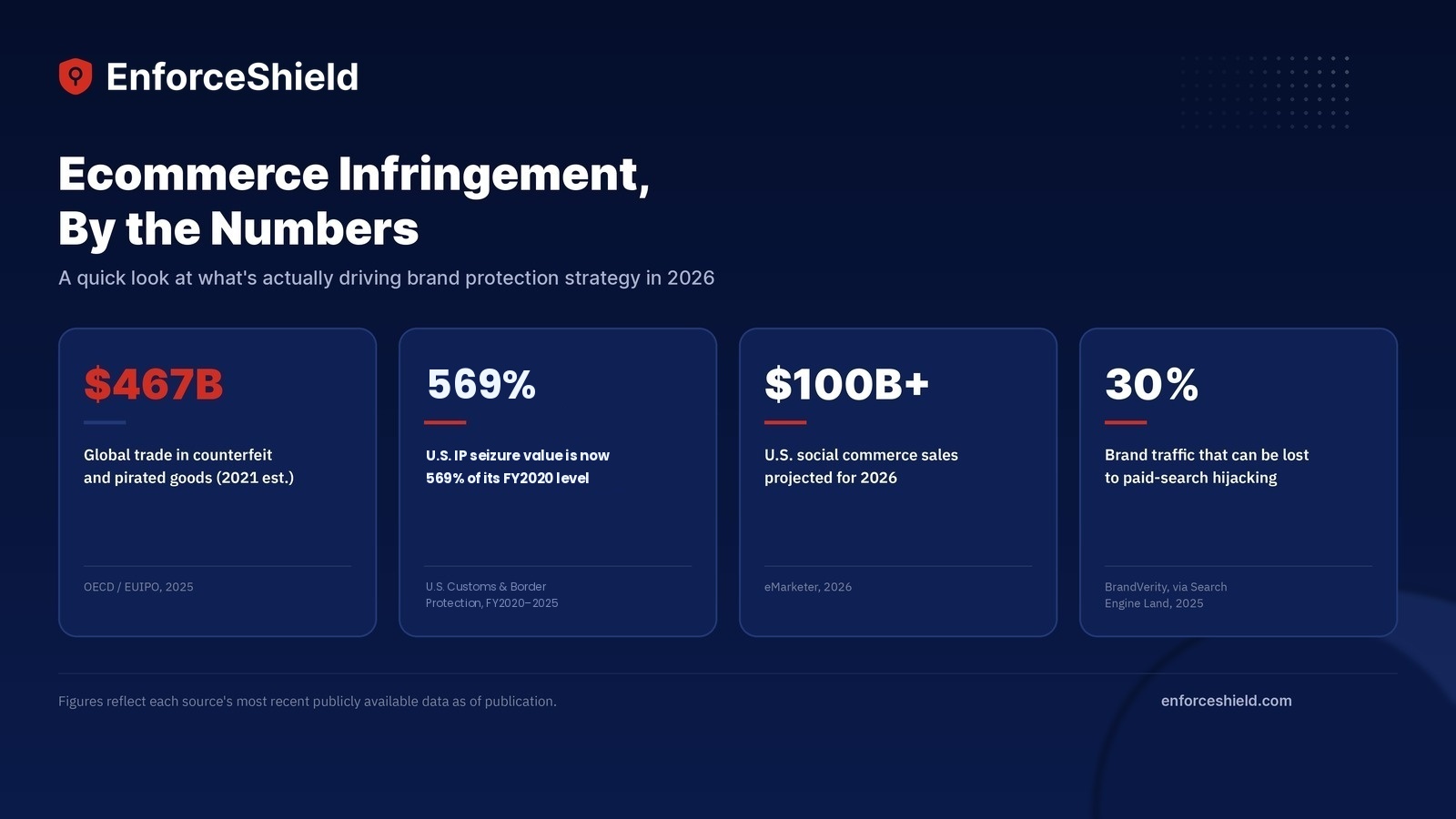
These numbers aren't meant to alarm. They just explain why the tactics below deserve real attention.
Listing hijacking: counterfeit attachment vs. unauthorized resale
Starting with the oldest one in the book: this is still one of the highest-volume channels we see, and the one teams underestimate most. It's, in fact, two different issues that get lumped together as "someone hijacked our listing."
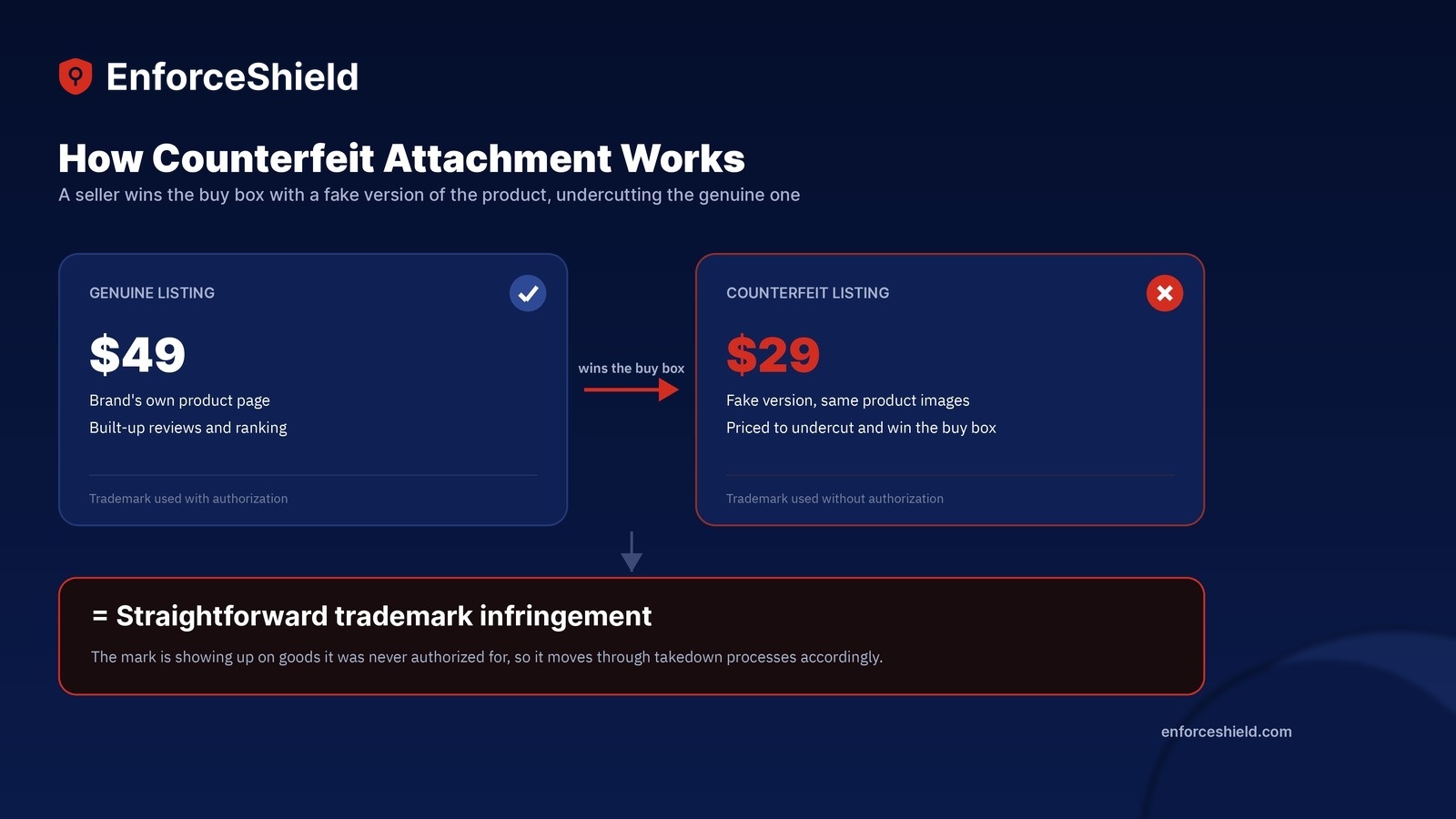
Counterfeit attachment is a seller winning the buy box with a fake version of the product while undercutting the genuine one. That's straightforward trademark infringement, and it moves through takedown processes accordingly.
Unauthorized resale is different. The seller is offering a genuine branded product, not a counterfeit bearing the brand's trademark, they've just attached it to a listing they were never authorized to sell on, riding the reviews and rankings someone else already built. Nothing here is counterfeit, so it's usually a distribution problem, not a takedown one. The one exception: if the actual goods differ from what the brand authorizes, different packaging, warranty, quality control, that can tip it right back into infringement.
Both eat into the same buy box and the same customer trust. Teams end up treating them as one issue, but mix them up and you'll end up filing the wrong kind of case. And honestly, the tactic sticks around because it's just easy: listings are public, undercutting takes minutes, and most marketplaces don't ask many questions before letting a seller attach a new offer to an existing page.
Synthetic counterfeits and deepfake endorsements
Counterfeit listings used to be easy to spot: bad packaging, a logo that looked a little off, photos that were clearly copied. That's changing fast. Now the packaging and serial numbers can look right enough that you'd need the real product next to it to tell the difference. Demo videos can fool you if you're not paying close attention. And the reviews? Written to sound like real customers, not like someone bought a batch.
That doesn't mean every listing needs a deep investigation. It just means old checks, like "do the photos look off," don't work as well anymore. Even regulators have noticed: the Federal Trade Commission's (FTC) 2024 rule against fake AI-generated reviews reflects how AI has made it cheaper to produce convincing fakes.
Social commerce impersonation
A growing share of buying decisions now start on social platforms rather than a marketplace search bar, and infringers have followed right along. Fake brand accounts, cloned profiles, and livestream shopping have all become an easy way to sell under a brand's name before anyone notices. Livestream shopping alone is reshaping how people buy: Asia-Pacific holds a 66.8% share of the global live commerce market, per Grand View Research, and platforms like TikTok Shop and Whatnot are extending that momentum into the U.S. and Europe. Most brands keep a close eye on marketplace listings. Social commerce gets watched far less consistently, and that's exactly the gap worth closing this year.
Borrowed search visibility
This one's sneaky: instead of copying the product, these sellers copy the attention around it. They load pages with a brand's own keywords, snap up lookalike domains, or just pay to show up when someone searches the brand's name. Search engines usually catch on and shut it down eventually. But "eventually" still means weeks of real traffic and real sales getting pulled away, often to a page built from scraped pricing, descriptions, and photos lifted straight from the original listing.
Pre-launch leaks
This one comes up a lot when I'm talking to founders before a launch, because it tends to surprise many people. Product details increasingly leak through Reddit threads, Discord servers, and private group chats well before an official release, and in some cases a counterfeit version appears for sale before the real product has even shipped.
The launch window has always carried extra risk. What's changed is how early that risk starts. If your brand protection strategy only begins the week you launch, it's already a step behind. See our guide on the 14-day window around a product launch for a deeper walkthrough.
Cross-border evasion, instant relisting, and hybrid operations
Taking down a listing rarely stops the operation behind it. Customs has a much harder time catching lots of small international shipments than one big one, so that's how a lot of it gets through. And a seller account that gets suspended today can be back up under a new name within days, sometimes hours.
That's why a single takedown never feels like the win it should. You've removed a listing. Not the seller, not the inventory, and definitely not the reason they started this in the first place. And increasingly, these aren't lone sellers running one storefront, they're running a real operation, manufacturing here, warehousing there, spread across a network of accounts, with that one listing just the piece you happened to notice. Watching a single channel won't cut it when they're already relisting somewhere else before your team's even finished writing up the first report.
What I'd do about all of this
None of this is a reason to panic, and it's not a sign a brand is doing something wrong if a few of these are already slipping through. It's a sign of a growing business, where volume and speed have outgrown a manual, check-it-when-we-notice process.
The brands handling this well in 2026 aren't the ones with the biggest legal team. They're building a brand protection strategy around continuous coverage across every channel where their name shows up: marketplaces, social platforms, search, ads, and their own site. In practice, that means shifting to attorney-engineered, machine-executed enforcement: moving at the speed infringers now operate at, able to tell a real infringement from a false alarm before anyone sorts through it by hand, and going straight into enforcement, with attorney-led escalation kept in reserve for the cases complex enough to need it.
That's the direction this is all moving, and it's exactly what we help clients do every day.
Sources
- OECD & EUIPO — Mapping Global Trade in Fakes 2025 (2021 data: $467B, 2.3% of world trade)
- U.S. Customs and Border Protection — FY2024 and FY2025 IPR seizure statistics
- eMarketer, via SQ Magazine — U.S. social commerce sales forecast to cross $100B in 2026
- Search Engine Land, citing BrandVerity research — paid-search trademark abuse intercepting up to 30% of brand traffic
- Federal Trade Commission — final rule banning fake and AI-generated reviews, effective Oct. 21, 2024
- Grand View Research — Live Commerce Market Size & Share Report, 2026-2033 (Asia-Pacific: 66.8% global revenue share, 2025)