

TL;DR
- Hour 0 turns the brand's scattered reality (trademarks, SKUs, packaging, reseller lists, markets) into rules the platform can check against.
- Hours 1-6 map the channels worth watching and calibrate detection thresholds — too loose fills day one with noise, too tight misses real cases.
- Hours 6-18 test candidates against the actual legal standard. A similar name isn't automatically infringement, and a fast wrong filing costs more than a slower correct one.
- Hours 18-24 move validated cases into enforcement. The first filing isn't when enforcement starts — it's the first visible result of a process already running.
I sit in on onboarding calls regularly, and potential clients keep asking the same thing: what really happens in that first 24 hours, beyond the sales deck. Here's the honest, hour-by-hour version of IP enforcement onboarding.
The first 24 hours break into four stages:
- Hour 0 — defining what "your brand" means to the platform
- Hours 1-6 — map the surface and get detection running
- Hours 6-18 — where the first real candidates get tested
- Hours 18-24 — move validated cases into enforcement
The important thing is that we do not wait until onboarding is complete to start moving. When a new client is coming on board and the onboarding is already agreed, we can begin preparing the organisation, brand information, marketplaces, and other parts of the enforcement setup in advance. That means that once the client officially comes on board, we are not starting from zero.
Enforcement keeps running well past hour 24, but let's dive into what really happens at each stage.
Hour zero: defining what "your brand" means to the platform
Before anything can be detected, EnforceShield needs a structured answer to something that is often scattered across different documents and systems: what exactly constitutes the brand's IP and enforcement scope.
That means taking a brand's scattered reality (registered trademarks, product SKUs, packaging assets, approved reseller lists, the markets it sells into) and turning it into something the platform can really check against. It's not enough to record "this trademark." The rule has to specify the product it's on, the market it's sold in, the channel it moves through, and who's authorized to sell it.
Without that context, the system can mistake legitimate activity, such as an authorized reseller, for an infringement.
That is why we start building this setup as early as possible. The goal is not to spend the first day preparing to enforce, but to have the foundations ready so that enforcement can start as soon as the first relevant results appear.
Hours one through six: map the surface and get detection running
EnforceShield builds targeted campaigns based on where the client wants to monitor for infringements: selecting the relevant marketplaces, social platforms, search terms, domains, and other sources where potential violations are most likely to appear.
This is also the stage where detection thresholds get calibrated, and that's trickier than it sounds. Once the campaigns are set up around the marketplaces, platforms, and search terms the client wants monitored, we need to fine-tune how the system identifies potential infringements. If the threshold is too loose, day one fills up with noise: generic products that happen to share a keyword, resellers who are authorized to sell, or near-matches that don't meet the legal bar for infringement. If it's too tight, real cases get missed, even though the dashboard still looks clean. Getting that calibration right for one specific brand is a big part of what onboarding onto a brand protection platform actually involves.
The difference is that we do not need to wait for every part of the setup to be perfect before we start seeing results. Once detection begins running, the first results give us an immediate view of what the brand is really facing. Those results also help us refine the campaigns and detection thresholds based on what we are seeing in the real world, rather than trying to get everything exactly right from the start.
Setup and enforcement are not two separate phases. They happen alongside each other. As campaigns begin generating results, the findings feed directly back into the setup. Searches can be refined, thresholds adjusted, and new sources added as we learn more about where and how the brand is being targeted. At the same time, valid infringements can already be identified and moved forward for enforcement.
Hours six through eighteen: where the first real candidates get tested
Once detection is live against the mapped surface, candidates start coming in, but a candidate still has to earn its way into becoming a case. Each one gets checked against whatever legal test applies: likelihood of confusion for a trademark match, likelihood of confusion plus non-functionality for trade dress, substantial similarity for copyright. This is the stage that can't be rushed just to hit a 24-hour number, because a fast wrong filing costs more than a slower correct one.
A similar name is not automatically trademark infringement. A visually similar product is not automatically counterfeit. And a marketplace seller is not automatically unauthorized.
The important part is that these candidates can be reviewed as the results come in, rather than waiting until the onboarding process is complete. When a case meets the required criteria, it can move forward.
Hours eighteen through twenty-four: move validated cases into enforcement
By the time a case clears validation, much of the work required to file it has already been completed: the platform, the jurisdiction-specific requirements, and the appropriate reporting template have been worked out during the initial setup. EnforceShield then prepares the report for submission, including the relevant infringement description, IP asset details, registration information, and other platform-specific requirements. Our team reviews the prepared report and submits it through the platform, rather than having to build and complete the entire report manually from scratch.
The first filing is not when enforcement starts. It is the first visible result of a process that has already been running.
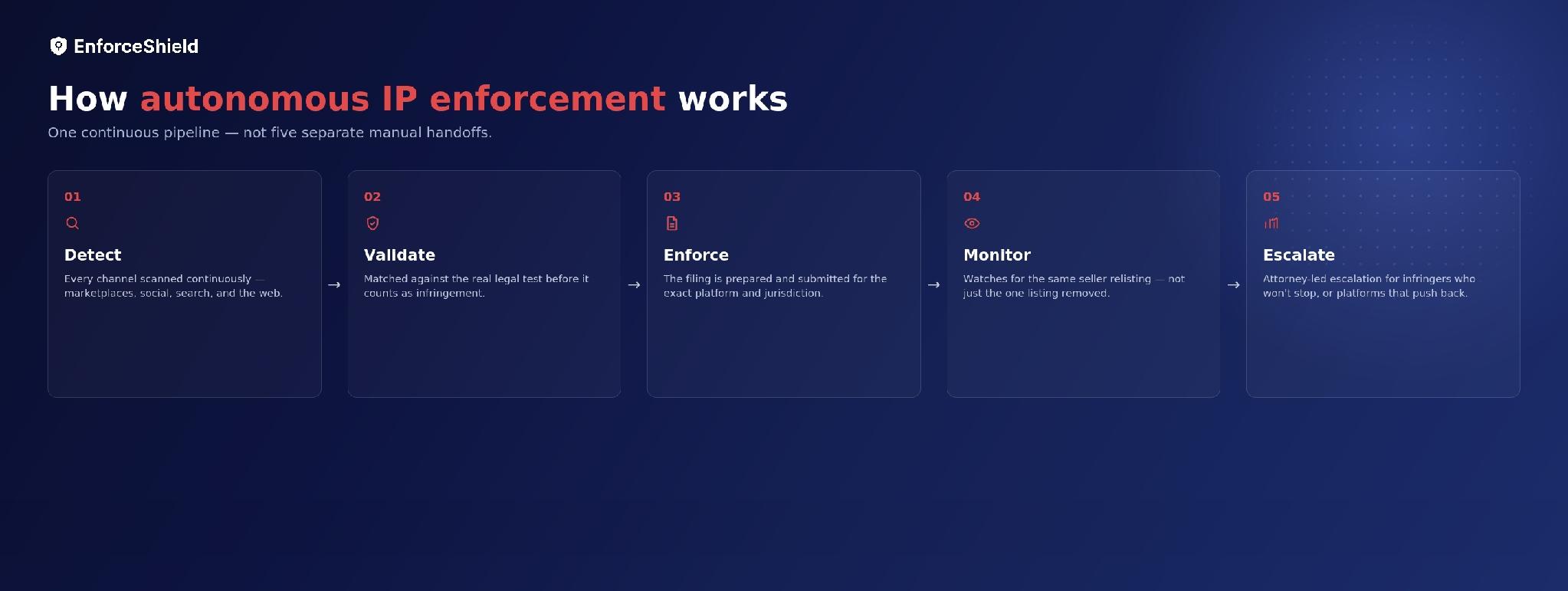
The same pipeline keeps running after hour 24: Detect, Validate, Enforce, Monitor, Escalate.
What "24 hours" promises, and what it doesn't
It's worth being precise about what this actually claims.
It means the first enforcement action can go out within 24 hours, provided the required inputs are available. It does not mean every instance of infringement targeting the brand is resolved by then.
The first 24 hours are not 24 hours of waiting to start enforcement. They are about getting enforcement moving quickly. Once the required inputs are in place, the platform helps move a validated case from detection to a prepared enforcement action without the usual back-and-forth of manual research, drafting, and filing.
And the work does not stop after that first action. Detection, validation, and filing continue well beyond day one, while monitoring for the same seller resurfacing picks up where the previous work left off.
That is the difference between a fake-listing alert tool and a brand protection platform. An alert tool flags something and hands it back to the brand to deal with. A brand protection platform stays on the case, reducing the manual workload while keeping enforcement moving as new infringements appear. That's what automated IP enforcement means here: the system does the repetitive work, and a person checks the calls that matter.
If you're weighing this against what your team is already doing in-house, we cover what autonomous IP enforcement actually is in detail. And if manual enforcement is the bottleneck you're trying to solve for, the data on why manual enforcement can't keep up lays out the cost.