

Most brands still buy brand IP protection the way they would buy a fire extinguisher: hang it on the wall, forget about it, and hope you never need it anyway. Somebody in the legal team signs a contract with a brand IP protection vendor after a bad quarter — a viral TikTok Shop knockoff, an Amazon storefront selling grey-market stock, a fake domain siphoning off paid traffic — and for a while, everyone pays attention. Then the fire's out, the vendor relationship quietly downgrades to a monthly report nobody reads closely, and the next crisis starts the whole cycle over.
That model is breaking down. The volume of infringement online has outgrown what a reactive approach to online brand protection can handle in stages.
How brand protection ended up as a point solution
Nobody planned it this way, it's just how the category grew up.
It was bought reactively. A specific incident (a counterfeit listing, a copied product photo, a phishing domain) triggered the purchase. The solution got scoped to that incident, not the underlying problem.
It was owned by whoever had the fire. Legal bought it to handle a takedown. Sometimes brand or marketing bought it to protect a launch. Rarely did it sit with anyone accountable for the ongoing exposure across the whole business.
It was measured in removals, not exposure. Success got defined as "we took something down," which feels like progress but says nothing about how much abuse is still out there, or how fast it's coming back.
It assumed infringement was occasional. The tooling, the staffing, the budget, all of it was sized for a handful of incidents a year, not a continuous stream across a dozen channels.
For a long time, that was a reasonable bet, and it's the brand protection strategy most companies still default to. Counterfeiting was slower, marketplaces were fewer, and a brand with a strong legal team could usually keep pace by responding to problems as they surfaced.
Why the reactive, manual model stopped working
Three things changed at once, and none of them are slowing down.
The number of channels multiplied. A brand used to worry about its own website and maybe Amazon. Now it's TikTok Shop, Instagram, Etsy, Temu, Walmart Marketplace, Meta ads, Google Shopping, and increasingly, whatever an AI search engine or shopping assistant decides to recommend. Every one of those is a new place for someone to impersonate you, list a knockoff, or run a copycat ad.
Counterfeit trade didn't slow down. It kept climbing. The most recent OECD-EUIPO study puts global trade in counterfeit and pirated goods at roughly USD 467 billion in 2021 — about 2.3% of world trade, and close to 4.7% of EU imports alone. Here's the part that matters more: around 65% of seizures now involve small parcels and mail. That's not a coincidence. That's counterfeiters following the same shift to direct-to-consumer shipping and social commerce that legitimate brands made. They didn't get better at dodging customs. They just started shipping the way everyone else does now.
The real cost isn't the incident. It's the delay. A listing that stays live three extra days doesn't just cost three days of sales. It costs search ranking. It costs reviews, once the fakes start piling up. It costs chargebacks. And customer trust doesn't just snap back once the listing's gone. Reactive programs are built to handle the incident. Nobody built them to handle the delay.
Put those three together and you get a workload that no longer fits inside "call the vendor when something's wrong." It has to run continuously, which is exactly the gap a true IP enforcement platform is built to close.
What "infrastructure" really means here
This isn't about doing more of the same thing. It's a different relationship to the problem, full stop, and it's why more teams now expect their brand protection platform to behave like infrastructure instead of a plug-in tool.
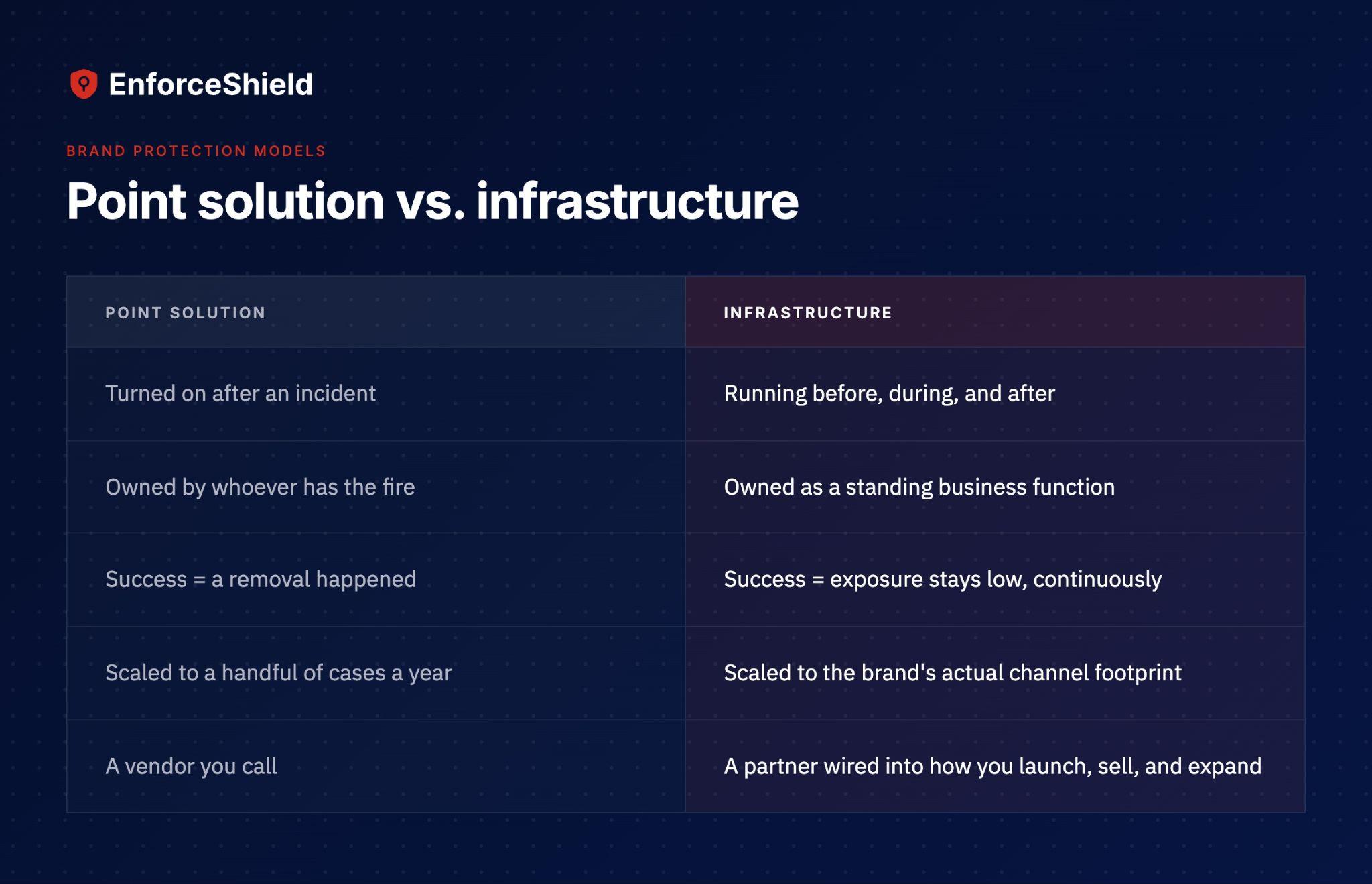
The practical difference shows up in a few specific ways:
It doesn't wait for a report to land in someone's inbox. It's already looking across marketplaces, social platforms, search, ads, and domains, so the first sign of a problem is a case, not a customer complaint.
It survives a change in headcount. A reactive program depends on one person's bandwidth and institutional memory. Infrastructure keeps working when that person is on vacation, changes roles, or leaves.
It's designed around recurrence, not one-time removal. Counterfeit listings and copycat storefronts come back under new names within days. A program built as infrastructure expects that and keeps checking, instead of treating each takedown as case closed.
More infringements doesn't mean more cost. Pricing tracks the brand's footprint: marketplaces, SKUs, channels. Add three marketplaces this year, that's what moves the number. Counterfeiters showing up after that are already covered.
What this means if you're the one buying it
This shift changes what actually matters when evaluating a brand protection partner or IP enforcement platform, and it's a different set of questions than the ones most RFPs still ask. If you want the longer version of that comparison, we break down the three architectures of brand protection software and when each one fits.
Ask what happens between incidents, not just during them. A partner that only shows up when you file a case is still a point solution, no matter what the sales deck says.
Ask how enforcement holds up against repeat offenders. A single removal that doesn't account for the same seller relisting under a new name three days later isn't infrastructure, it's a one-time favor.
Ask where legal judgment sits in the process. Enforcement decisions carry legal weight: what counts as infringement, how a claim gets built, when escalation makes sense. A workflow that skips that step to move faster usually creates risk instead of removing it.
Ask how protection scales with you. If going viral this week means renegotiating your contract next week just to keep the same coverage, somebody sold you a project and called it a platform.
Where EnforceShield fits into this shift
This is the model the EnforceShield brand protection platform was built around from day one, not something we bolted on after the fact. We're an attorney-engineered, machine-executed autonomous IP enforcement platform built for multichannel ecommerce brands: companies dealing with infringement across marketplaces, social platforms, search, websites, and domains at the same time, not just on one channel.
The workflow runs in five stages, and it's designed to keep running rather than stop after a single win:
- Detect — find counterfeits, unauthorized sellers, stolen creative, impersonation, and brand abuse across marketplaces, social platforms, websites, and search.
- Validate — analyze each case against legal logic, platform context, and enforcement criteria before anything moves forward.
- Enforce — run platform-specific takedowns across marketplaces, social platforms, websites, search, ads, and reseller channels.
- Monitor — track resolved cases and repeat offenders, and catch violations when they reappear.
- Escalate — for the complex or persistent cases that don't resolve through a standard platform takedown, attorney-led escalation takes it further.
That last step matters: escalation isn't a routine part of every case, it's what happens when the standard path doesn't get the job done, which is exactly the kind of judgment call that shouldn't be automated away.
Most brands are live within 24 hours of onboarding, not the weeks it usually takes to stand up an enterprise tool. The legal judgment behind every case comes from over a decade of IP enforcement work, built directly into how the system decides what to do. From there, it's up to the brand: review and approve every filing, or set the rules and let it run on its own, depending on what fits their brand protection strategy.
The takeaway
Brand protection stopped being a tool you reach for during a crisis a while ago. Most contracts just haven't caught up to that yet. The brands that treat it as infrastructure — always running, owned as a real function, built to grow with the business — are the ones that stop having the same fire drill every quarter.
If you're rethinking what your brand protection strategy should actually look like, that conversation is worth having before the next incident forces it.
Source: OECD/EUIPO, "Mapping Global Trade in Fakes 2025: Global Trends and Enforcement Challenges" (2025), based on 2021 customs seizure data.